 Login

Cart
CloseNo products in the shopping cart.


No products in the shopping cart.
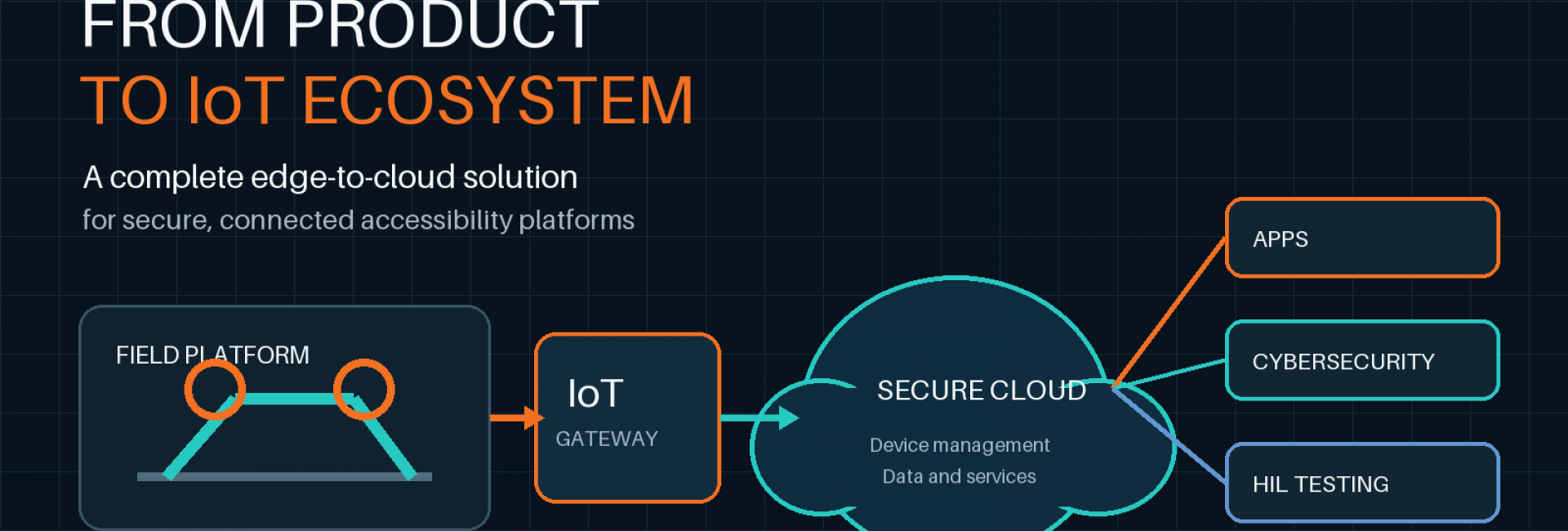

From Mobility Equipment to Connected Platforms: A Complete IoT Case History
A leading European manufacturer of mobility and accessibility solutions wanted to evolve its product portfolio into a connected ecosystem.
Its platforms operate across residential, public and commercial environments. This distributed installed base created a complex technological challenge: connecting products securely while providing users, service teams and technical personnel with the right digital tools.
The project required much more than adding connectivity to an existing device. The manufacturer needed a complete IoT architecture capable of supporting the entire connected-product lifecycle—from field communication and data collection to cloud services, user applications, cybersecurity monitoring and system validation.
The main objectives included:
Delivering these capabilities through separate suppliers would have introduced additional integration effort, fragmented responsibilities and greater maintenance complexity. The manufacturer therefore needed a technology partner able to manage the complete edge-to-cloud architecture.
DAVE Embedded Systems designed and delivered a complete IoT solution covering the entire data path, from the connected product to the cloud and the applications used to interact with it.
The solution combines five main elements:
By developing these elements as part of a single architecture, DAVE reduced integration complexity and created a consistent environment for connectivity, monitoring, maintenance and future service development.
At the edge of the system, the communication gateway acts as the bridge between the customer’s platforms and the cloud infrastructure.
It collects relevant information from the product, manages communication with the remote platform and provides the foundation for secure digital services.
The gateway was designed to address key industrial requirements, including:
This approach allows connectivity to become an integral part of the platform architecture rather than an isolated add-on.
The cloud layer centralizes information from connected products and makes it available to authorized users through dedicated interfaces.
Different applications and access profiles can support the needs of end users, service personnel and technical teams. Depending on the assigned role, users can access relevant product information, status data, notifications and diagnostic functions.
The digital ecosystem was designed to support:
This architecture transforms field data into actionable information, helping technical teams understand product status and respond more efficiently when support is required.
For connected products, cybersecurity cannot be limited to the initial design phase. It must remain active throughout the product lifecycle.
DAVE integrated cybersecurity into the complete architecture, from the communication gateway to cloud services and applications.
The solution includes measures designed to support:
The monitoring layer gives the manufacturer greater visibility into the security posture of its connected ecosystem and supports a proactive approach to emerging risks.
A connected service must be validated not only at software level, but also against the behavior of the physical product.
For this reason, Hardware-in-the-Loop testing was included in the solution. The HIL environment makes it possible to reproduce operating conditions and verify how the customer’s platforms interact with the gateway, cloud services and applications.
The test infrastructure supports activities such as:
By combining physical interfaces with automated test scenarios, HIL testing reduces dependence on manual field validation and helps identify integration issues earlier in the development cycle.
| Challenge | DAVE Embedded Systems’ solution | Main benefit |
|---|---|---|
| Connecting products installed in different environments | Embedded communication gateway and secure connectivity layer | A consistent connection between field products and digital services |
| Fragmented operational information | Centralized cloud platform | Unified access to product status, events and diagnostic data |
| Different requirements for users and service teams | Dedicated applications and role-based interfaces | Relevant tools and information for each user profile |
| Limited remote visibility | Monitoring dashboards, alerts and diagnostic functions | Faster access to information for support and maintenance |
| Growing cybersecurity exposure | Continuous cybersecurity monitoring and controlled access | Greater visibility and protection across the connected ecosystem |
| Complex system-level validation | Hardware-in-the-Loop test platform | Repeatable testing of hardware, software, cloud and application interactions |
| Multiple technologies and suppliers | Complete edge-to-cloud delivery by one technology partner | Reduced integration effort and clearer technical responsibility |
| Need to support future services | Modular and scalable IoT architecture | A foundation that can evolve with products and business requirements |
The project created a unified technological foundation for transforming traditional mobility equipment into connected platforms.
The manufacturer can now build digital services around product data while maintaining a consistent architecture across the gateway, cloud, applications, cybersecurity processes and validation environment.
The solution was designed to deliver several strategic advantages:
Most importantly, the project established an architecture that can evolve over time. New product families, application features, monitoring functions and service models can be introduced without redesigning the entire ecosystem.
This case history demonstrates that a successful IoT project is not simply a connectivity project.
It requires coordinated expertise in embedded hardware, communication technologies, cloud software, application development, cybersecurity and system-level testing.
By taking responsibility for the complete solution—from the field gateway to user applications and validation infrastructure—DAVE Embedded Systems helped the customer manage this complexity through a single technology partner.
The result is an integrated and scalable IoT ecosystem designed to support safer, smarter and more service-oriented mobility platforms.
Are you looking to transform your products into secure, connected platforms?
DAVE Embedded Systems can support the complete journey—from embedded gateways and cloud integration to applications, cybersecurity monitoring and Hardware-in-the-Loop validation.
Contact our team to discuss your next IoT project.
Welcome to the DAVE Embedded Systems' technical information form submission portal!
Please fill in the fields below. The support team will take care of you in maximum 24h!
Welcome to the DAVE Embedded Systems' Documentation system. Please fill in with required information and you will get your document! Thank you!.
We use cookies to personalize content, to get traffic statistics and to improve your experience on our website.
Please read our Cookie Policy for a more detailed description and click on the "Manage preferences" button to customize how the site uses cookies for you. By clicking on "Accept all cookies" you give your consent for the use of each type of cookie.
These cookies are necessary for the website to function and cannot be switched off in our systems.
You can set your browser to block or alert you about these cookies, but some parts of the site will not then work. These cookies do not store any personally identifiable information.
These cookies allow us to count visits and traffic sources so we can measure and improve the performance of our site. They help us to know which pages are the most and least popular and see how visitors move around the site.
All information these cookies collect is aggregated and therefore anonymous. If you do not allow these cookies we will not know when you have visited our site, and will not be able to monitor its performance.
Select all Deselect all