Home
> Case histories
> Breaking the Throughput Barrier: Enabling High-Speed Communications for Next-Generation Small Satellites
Breaking the Throughput Barrier: Enabling High-Speed Communications for Next-Generation Small Satellites
In the rapidly evolving space economy, the ability to transmit vast amounts of data quickly and reliably is becoming a decisive competitive advantage. A forward-looking satellite operator set out to overcome the traditional limits of small satellite communications by adopting a new generation of high-throughput, compact SDR technology. The result is a breakthrough in performance, flexibility, and mission efficiency.
SDR – Key Technical Specifications
Category
Parameter
Value
General
Type
Software Defined Radio (SDR)
Target platform
CubeSat & Small Satellites (LEO/GEO)
Processing Architecture
Main Processor
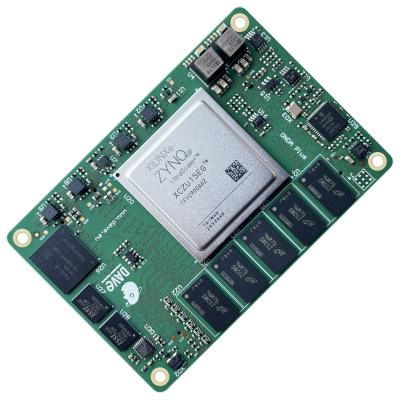
CPU AMD Ultrascale+ XZU6EG or XZU9EG or XZU15EG
FPGA
CPU AMD Ultrascale+ XZU6EG or XZU9EG or XZU15EG
Mixed Front End (MXFE)
Analog Devices AD9081
Performance
TX Data Rate
Up to 4 Gbps
RX Data Rate
Up to 1 Gbps
RX Channels
2 x 1 GHz IBW
TX Channels
2 x 1 GHz IBW
Frequency Range
300 MHz – 7 GHz
Instantaneous Bandwidth
Up to 1 GHz
Protocols & Features
Supported Standards
DVB-S2X (ACM), CCSDS
Custom Waveforms
Supported
In-Orbit Reconfiguration
Firmware & protocols reprogrammable
Reliability
Redundant boot, watchdog timers
Interfaces
RF Interfaces
SMP gold plated connectors
Data Interfaces
SpaceFibre (opt. SpaceWire, Ethernet)
Control Interfaces
CSP over CAN (opt. Ethernet, RS422)
Additional Interfaces
UART, SPI, I2C
Power
Power Consumption
< 35 W
Input Voltage
12 V – 24 V
Mechanical
Dimensions
83.5 × 96 × 25 mm
Volume
< 0.5U
Mass
< 500 g
Environment
Operating Temperature
-20 °C to +70 °C
Non-operating Temperature
-30 °C to +90 °C
Qualification
Vibration & TVAC (ECSS compliant)
Project Story
As satellite constellations grow and Earth observation missions become more data-intensive, the challenge is no longer just collecting information—but delivering it to ground efficiently and without delay.
Facing increasing pressure to improve data downlink capacity while maintaining strict constraints on size, weight, and power, the customer needed a solution that could keep pace with next-generation mission demands. Traditional communication systems were simply not sufficient.
The project centered on integrating a cutting-edge Software Defined Radio (SDR) platform capable of radically enhancing communication performance. Despite its extremely compact footprint—less than 0.5U in volume and under 500 grams in weight—the solution delivers exceptional throughput, reaching up to 4 Gbps in transmission and 1 Gbps in reception.
What truly transformed the mission architecture was flexibility. Operating across a wide frequency spectrum from 300 MHz to 7 GHz, and supporting both standard protocols (such as DVB-S2X and CCSDS) and custom waveforms, the platform enabled the customer to adapt seamlessly to different mission scenarios—from Earth observation data downlink to inter-satellite communications.
Even more importantly, the system introduced a new level of future-readiness: the ability to reprogram firmware and communication protocols directly in orbit. This meant that the satellite could evolve throughout its lifecycle, adapting to new requirements without costly redesigns or replacements.
The Role of DAVE
DAVE Embedded Systems was a key enabler in turning this vision into reality.
Bringing deep expertise in embedded and space-grade technologies, DAVE engineered and delivered a highly integrated SDR platform designed specifically for the challenges of small satellites. The company worked across the full development lifecycle—from hardware design to software integration—ensuring a robust, high-performance solution.
Reliability was a core focus. The platform incorporates advanced features such as redundant boot mechanisms, watchdog systems, and secure in-orbit reprogramming capabilities, ensuring continuous operation even in harsh space environments.
DAVE also ensured that the system met rigorous space qualification standards, including thermal and vibration testing, guaranteeing mission readiness under extreme conditions.
By combining performance, modularity, and configurability, DAVE enabled the customer to deploy a tailored solution without sacrificing time-to-market or scalability.
Customer Benefits
The impact for the end customer was immediate and strategic.
First, the dramatic increase in data throughput unlocked new possibilities for mission performance. High-resolution data could be transmitted faster, enabling near-real-time insights and significantly improving the value of collected information.
Second, the flexibility of the SDR architecture allowed the customer to future-proof their investment. With support for multiple standards and customizable protocols, the system can adapt to evolving mission requirements and communication environments.
Third, the compact size and low power consumption simplified system integration and reduced launch costs—critical factors in the economics of small satellite missions.
Finally, the ability to update and optimize the system in orbit ensures long-term operational efficiency, reducing risk and extending the useful life of the satellite.
Welcome to the DAVE Embedded Systems' technical information form submission portal! Please fill in the fields below. The support team will take care of you in maximum 24h!
Register to download the file.
Welcome to the DAVE Embedded Systems' Documentation system. Please fill in with required information and you will get your document! Thank you!.
Cookie consent
We use cookies to personalize content, to get traffic statistics and to improve your experience on our website.
Please read our Cookie Policy for a more detailed description and click on the "Manage preferences" button to customize how the site uses cookies for you. By clicking on "Accept all cookies" you give your consent for the use of each type of cookie.
Necessary cookies
+
These cookies are necessary for the website to function and cannot be switched off in our systems.
You can set your browser to block or alert you about these cookies, but some parts of the site will not then work. These cookies do not store any personally identifiable information.
XSRF-TOKEN Accept
laravel_session Accept
laravel_shopping_cart Accept
laravel_cookie_consent Accept
laravel_cookie_consent_* Accept
Statistics cookies
(0/1)
+
These cookies allow us to count visits and traffic sources so we can measure and improve the performance of our site. They help us to know which pages are the most and least popular and see how visitors move around the site.
All information these cookies collect is aggregated and therefore anonymous. If you do not allow these cookies we will not know when you have visited our site, and will not be able to monitor its performance.
 Login
Login